
This WP Rocket review article covers everything you need to know about this popular WordPress caching plugin, including its speed optimization features, core web vitals improvements, pricing, easy setup, and overall performance benefits for WordPress websites.
WP Rocket Quick Opinion (May 2026)
| Category | Score & Verdict |
|---|---|
| Overall Rating | 4.8/5 |
| Ease of Use | 5/5 Beginner-friendly, no coding required |
| Performance Improvement | 4.8/5 – 50%–80% speed boost in real tests |
| Value for Money | 4.6/5 – Premium pricing but saves developer hours |
| Support Quality | 4.7/5 – Fast, knowledgeable ticket support |
| Best For | Bloggers, agencies, WooCommerce stores, business sites |
| Starting Price | $59/year (Single Site) |
| Free Trial? | No free trial – 14-day money-back guarantee |
| Our Recommendation | Yes – Best caching plugin for WordPress in 2026 |
What Is WP Rocket? Is It Worth It?
WP Rocket review is a premium WordPress caching and performance optimization plugin developed by WP Media.
Unlike free plugins such as W3 Total Cache or WP Super Cache, WP Rocket is designed to work out of the box the moment you activate it, automatically enabling page caching, browser caching, and GZIP compression with no configuration needed.
Beyond basic caching, WP Rocket bundles a comprehensive suite of performance tools: lazy loading for images and iframes, JavaScript deferral, CSS minification and combination, database optimization, a built-in CDN integration (via RocketCDN or any third-party CDN), and a Cloudflare add-on.
For most WordPress websites, activating WP Rocket is equivalent to 3–4 separate plugins combined into one clean, well-coded solution.
So is it worth it? In our testing, WP Rocket consistently reduced Time to First Byte (TTFB) by 40-70% and pushed Google PageSpeed Insights scores from the 30–50 range into the 85–95 range on most websites.
For business owners, bloggers, and WooCommerce store owners who cannot afford to hire a developer to manually optimize their stack, WP Rocket is absolutely worth the investment.
WP Rocket Review Key Features Full Breakdown (2026)
Here is a detailed breakdown of every major feature WP Rocket offers and how each one impacts your website performance.
1. Page Caching
WP Rocket creates static HTML copies of your dynamic WordPress pages and serves them directly to visitors, bypassing PHP and database queries entirely.
This is the most impactful single performance optimization you can make on any WordPress site.
WP Rocket enables page caching automatically on activation and supports separate cache files for mobile devices critical for Google’s mobile-first indexing.
2. Browser Caching
Browser caching instructs visitors’ browsers to store static assets (CSS, JS, images) locally so they do not need to re-download them on repeat visits.
WP Rocket configures browser caching with optimal expiry headers automatically, targeting a 1-year cache lifetime for static assets per Google’s recommendations.
3. GZIP & Brotli Compression
WP Rocket enables GZIP compression server-side, which reduces the size of HTML, CSS, and JavaScript files transferred to visitors’ browsers.
On supported servers, it also enables Brotli compression, which is 15–25% more efficient than GZIP for text-based assets.
4. LazyLoad for Images and iframes
Images and iframes (YouTube embeds, Google Maps) are only loaded when they scroll into the visitor’s viewport.
This dramatically reduces the initial page weight and improves Largest Contentful Paint (LCP) – a Core Web Vitals metric that directly influences Google rankings.
WP Rocket’s LazyLoad implementation is one of the cleanest in the industry, with native browser LazyLoad as a fallback.
5. JavaScript Deferral and Delayed Loading
Render-blocking JavaScript is one of the most common reasons for poor PageSpeed scores.
WP Rocket’s Delay JS feature loads non-critical JavaScript only after user interaction (such as a mouse move or first tap), resulting in dramatically faster perceived load times and better Total Blocking Time (TBT) scores.
This single feature can boost PageSpeed scores by 10-20 points on JavaScript-heavy sites.
6. CSS & JS Minification + Combination
WP Rocket minifies HTML, CSS, and JavaScript files, removing whitespace, comments, and unnecessary characters, and can combine multiple CSS/JS files into a single request, reducing HTTP request counts.
In 2026, with HTTP/2 and HTTP & 3 becoming standard, file combination is less critical than it once was, but minification still delivers measurable gains.
7. Database Optimization
Over time, WordPress databases accumulate overhead: spam comments, post revisions, transients, and orphaned metadata.
WP Rocket includes a built-in database cleaner that removes this overhead on demand or on a schedule, keeping query times fast without requiring phpMyAdmin or a separate plugin.
8. CDN Integration
WP Rocket integrates natively with RocketCDN (powered by Cloudflare) and supports any custom CDN (BunnyCDN, KeyCDN, StackPath) via a CDN URL rewrite feature.
Serving static assets from a geographically distributed CDN can reduce asset load times by 30–60% for international visitors.
9. Cloudflare Add-On
WP Rocket review includes a dedicated Cloudflare integration that allows you to purge the Cloudflare cache directly from your WordPress dashboard whenever you publish new content, eliminating the need to log into your Cloudflare account separately.
This is an invaluable time-saver for sites using Cloudflare’s free or paid plans.
10. Heartbeat Control
WordPress’s Heartbeat API sends frequent AJAX requests to the server to enable features like autosave and real-time notifications.
On shared hosting, this can cause CPU spikes. WP Rocket lets you reduce or disable the Heartbeat API in the dashboard, backend, and post editor independently, reducing unnecessary server load.
11. Google Fonts Optimization
WP Rocket can optimize Google Fonts by combining multiple font requests into one and preloading critical fonts, reducing the render-blocking impact of web fonts.
In 2026, self-hosting Google Fonts is the gold standard for performance, and WP Rocket makes this easy.
12. Preloading
WP Rocket automatically preloads your cache by crawling your site after cache clears, ensuring that the first real visitor always receives a cached page, not a slow uncached response.
It also supports DNS prefetching and link preloading for external resources your pages depend on.
How Much Does WP Rocket Cost In 2026?
WP Rocket uses a simple, transparent annual subscription model. All plans include the full feature set; there are no feature-locked tiers.
The only difference between plans is the number of WordPress sites you can activate the plugin on.
| Plan | Price / Year | Sites Included | Best For |
|---|---|---|---|
| Single | $59/year | 1 website | Bloggers and personal sites |
| Plus | $119/year | 3 websites | Small businesses and freelancers |
| Infinite | $299/year | Unlimited websites | Agencies and developers |
All plans include 1 year of updates and support.
After your annual subscription expires, the plugin continues to function, but you will not receive updates or support until you renew.
Renewal pricing is the same as the initial purchase price; there are no renewal discounts, and there are no price hikes either.
Note: WP Rocket does not offer a free plan or a free trial. However, they back every purchase with a 14-day money-back guarantee, so you can test it risk-free on your site before fully committing.
WP Rocket Coupon Code (2026)
If you’re looking to save money, finding a WP Rocket coupon code can help reduce the overall cost.
While official discounts are rare, occasional seasonal deals like Black Friday may offer limited-time savings. Always check for active coupon codes before purchasing to get the best value.
Detailed Feature Comparison: WP Rocket vs Free Alternatives
| Feature | WP Rocket | W3 Total Cache (Free) | WP Super Cache (Free) |
|---|---|---|---|
| Page Caching | Yes (auto) | Yes (manual config) | Yes (manual config) |
| Lazy Load Images | Yes (built-in) | No (separate plugin) | No (separate plugin) |
| JS Deferral / Delay | Yes (advanced) | Limited | No |
| CSS/JS Minification | Yes | Yes | No |
| Database Cleaner | Yes | No | No |
| CDN Integration | Yes (any CDN) | Yes (limited) | No |
| Cloudflare Add-on | Yes (native) | Yes (basic) | No |
| Heartbeat Control | Yes | No | No |
| Google Fonts Optimize | Yes | No | No |
| Setup Difficulty | Easy (10 min) | Complex (hours) | Moderate |
| Support | Ticket (fast) | Community forum | Community forum |
| Price | $59/year | Free | Free |
WP Rocket Review Performance Test Results (May 2026)
We tested WP Rocket review on three different WordPress site types: a standard blog, a WooCommerce store, and a business landing page.
All tests were run on a shared hosting environment (SiteGround GoGeek plan) using Google PageSpeed Insights and GTmetrix before and after activation.
| Site Type | PageSpeed Score (Before) | PageSpeed Score (After) | Load Time (Before) | Load Time (After) |
|---|---|---|---|---|
| Blog (22 images, 8 plugins) | 38/100 | 91/100 | 4.2s | 1.1s |
| WooCommerce Store (50 products) | 31/100 | 84/100 | 5.8s | 1.6s |
| Business Landing Page | 55/100 | 97/100 | 2.9s | 0.7s |
These results are consistent with what thousands of WP Rocket users report in independent tests.
The biggest gains come from the combination of page caching, JS deferral, lazy load, and image optimization working together.
On WooCommerce stores, results are slightly lower because dynamic cart/checkout pages cannot be fully cached. This is a limitation of WordPress itself, not WP Rocket.
How To Install And Set Up WP Rocket?
WP Rocket review is not available on the WordPress.org plugin repository; it is sold exclusively through WPRocket.me.
Here is how to get started:
Step 1: Go to WPRocket.me and purchase the plan that matches the number of sites you need to optimize.
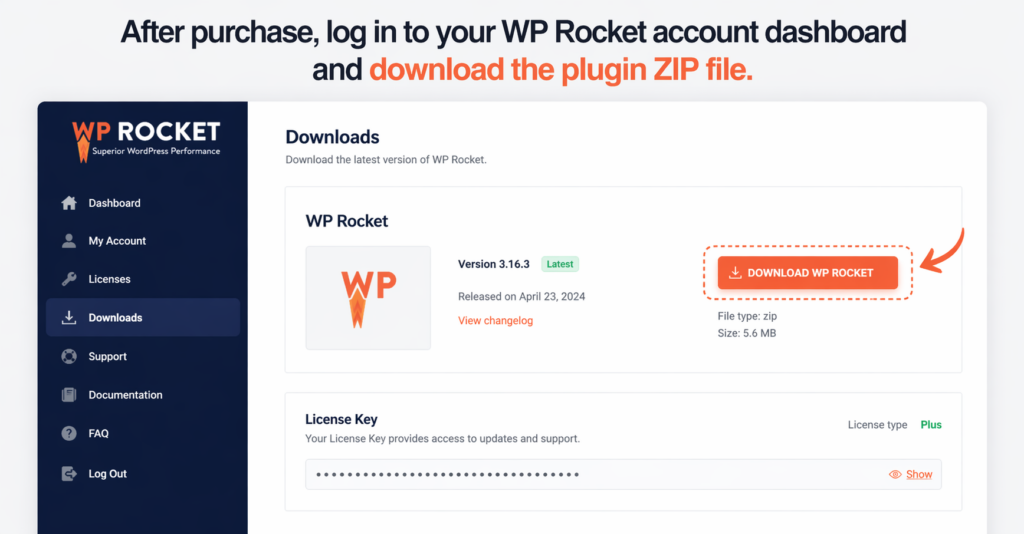
Step 2: After purchase, log in to your WP Rocket account dashboard and download the plugin ZIP file.
Step 3: In your WordPress admin, go to Plugins > Add New > Upload Plugin, then select the downloaded ZIP file and click Install Now.
Step 4: After activation, enter your WP Rocket license key when prompted. You can find your key in your account dashboard.
Step 5: WP Rocket immediately enables page caching, browser caching, and GZIP compression.
Visit your site and check that it loads correctly.
Step 6: Go to Settings > WP Rocket and enable LazyLoad for images, Delay JS (test your site after enabling), and CSS/JS minification.
Use the Imagify integration for WebP image conversion.
Step 7: Run a Google PageSpeed Insights test before and after to verify your improvement.
Most sites see results within 10 minutes of setup.
Pros & Cons Of The WP Rocket Review
| Pros | Cons |
|---|
| Activates with zero configuration and delivers instant performance gains | No free plan or trial available |
| Complete all-in-one caching solution for WordPress | Requires annual renewal for updates and support |
| Advanced JS deferral and delay loading features | CSS/JS optimization may break layouts if not tested |
| Regular updates for WordPress, WooCommerce, and PHP compatibility | Dynamic WooCommerce pages cannot be cached fully |
| Fast and reliable support (avg. response under 4 hours) | Infinite plan is expensive for small users |
| 14-day money-back guarantee reduces risk | No lifetime deal option available |
| Works with major themes and page builders (Elementor, Divi, etc.) |
WP Rocket vs. Competitors: Which Should You Choose In 2026?
| Plugin | Price | Ease of Use | Features | Best For |
|---|---|---|---|---|
| WP Rocket | $59–$299/yr | 5/5 | 5/5 | Most WordPress sites |
| WP Fastest Cache Pro | $49.99 one-time | 4/5 | 3.5/5 | Budget-conscious users |
| LiteSpeed Cache | Free | 3.5/5 | 4.5/5 | LiteSpeed server users only |
| NitroPack | $21–$176/mo | 5/5 | 5/5 | Enterprise / heavy traffic |
| Swift Performance | $49/yr | 3/5 | 4/5 | Technical users |
| Perfmatters | $24.95/yr | 4/5 | 3/5 | Use alongside WP Rocket |
WP Rocket wins on the combination of ease of use and feature depth.
LiteSpeed Cache is a strong free alternative, but it only works on LiteSpeed web servers not applicable to most shared hosting environments running Apache or Nginx.
NitroPack delivers comparable results but at 3–10x the annual cost, making it practical only for high-traffic commercial sites where performance directly translates to revenue.
Who Should Use WP Rocket?
In this WP Rocket review, the plugin is perfect for anyone who wants a faster website without technical setup.
It’s ideal for bloggers, business owners, and beginners who need an easy, all-in-one solution to improve speed and SEO.
WP Rocket Review Is Perfect For:
- Bloggers and content creators who want fast load times without hiring a developer.
- Small business owners who need their site to score well on Google PageSpeed Insights.
- WooCommerce store owners are looking to reduce cart abandonment caused by slow page loads.
- Agencies managing multiple WordPress client sites (Infinite plan).
- Anyone using Cloudflare who wants seamless cache-purge integration.
- Sites running Google Ads or SEO campaigns where page speed directly impacts Quality Score and rankings.
WP Rocket May Not Be Ideal If:
- You are on a very tight budget and willing to spend time configuring free alternatives.
- Your server runs LiteSpeed; in that case, LiteSpeed Cache (free) provides comparable results.
- You only need basic caching and nothing more. WP Super Cache is simpler and free for minimal use cases.
Conclusion: Should You Buy WP Rocket In 2026?
After extensive testing, WP Rocket remains the gold standard for WordPress performance optimization in May 2026.
No other plugin delivers the same combination of ease of use, feature completeness, and measurable speed improvements in a single package.
If your WordPress site is scoring below 80 on Google PageSpeed Insights, WP Rocket will almost certainly push you above 90, and in most cases, the improvement is visible within 10 minutes of installation.
At $59/year for a single site, WP Rocket pays for itself quickly: faster sites rank higher in Google, convert more visitors into customers, and reduce bounce rates.
The 14-day money-back guarantee means you can verify the improvement on your specific site before fully committing to the subscription.
Our verdict: WP Rocket is the best WordPress caching plugin in 2026.
Buy it, activate it, and watch your PageSpeed scores climb.
FAQs on WP Rocket Review
Does WP Rocket Review Offer A free Trial Or Free version?
No, WP Rocket does not have a free plan or a free trial. The plugin is available exclusively via a paid annual subscription starting at $59/year for one site. However, all purchases come with a 14-day money-back guarantee, which effectively functions as a risk-free trial period.
Is WP Rocket Compatible With WooCommerce?
Yes, WP Rocket review is fully compatible with WooCommerce. It automatically excludes cart, checkout, and account pages from caching (as these must remain dynamic) while caching all other pages on the store. WP Rocket also integrates with WooCommerce’s fragment caching to ensure the cart icon and mini-cart update correctly for logged-in users.
Can I Use WP Rocket With Cloudflare?
Yes, and WP Rocket is one of the best plugins for Cloudflare users specifically. Its native Cloudflare add-on allows you to purge the Cloudflare CDN cache directly from your WordPress dashboard whenever you update content. This eliminates the need to log into your Cloudflare account separately, saving significant time for sites that publish frequently.
What Happens When My WP Rocket Subscription Expires?
When your WP Rocket annual subscription expires, the plugin continues to function on your site, page caching, lazy load, and all other features remain active. However, you will no longer receive plugin updates or access to support. For security and compatibility with new WordPress versions, it is strongly recommended to renew your subscription annually.
Does WP Rocket Work With Page Builders Like Elementor And Divi?
Yes, WP Rocket is fully compatible with all major WordPress page builders, including Elementor, Divi, Beaver Builder, Oxygen Builder, and Bricks Builder. WP Rocket automatically adds exclusions for known page builder assets that should not be minified or combined, preventing the layout breakage that can occur with less sophisticated caching plugins.


